
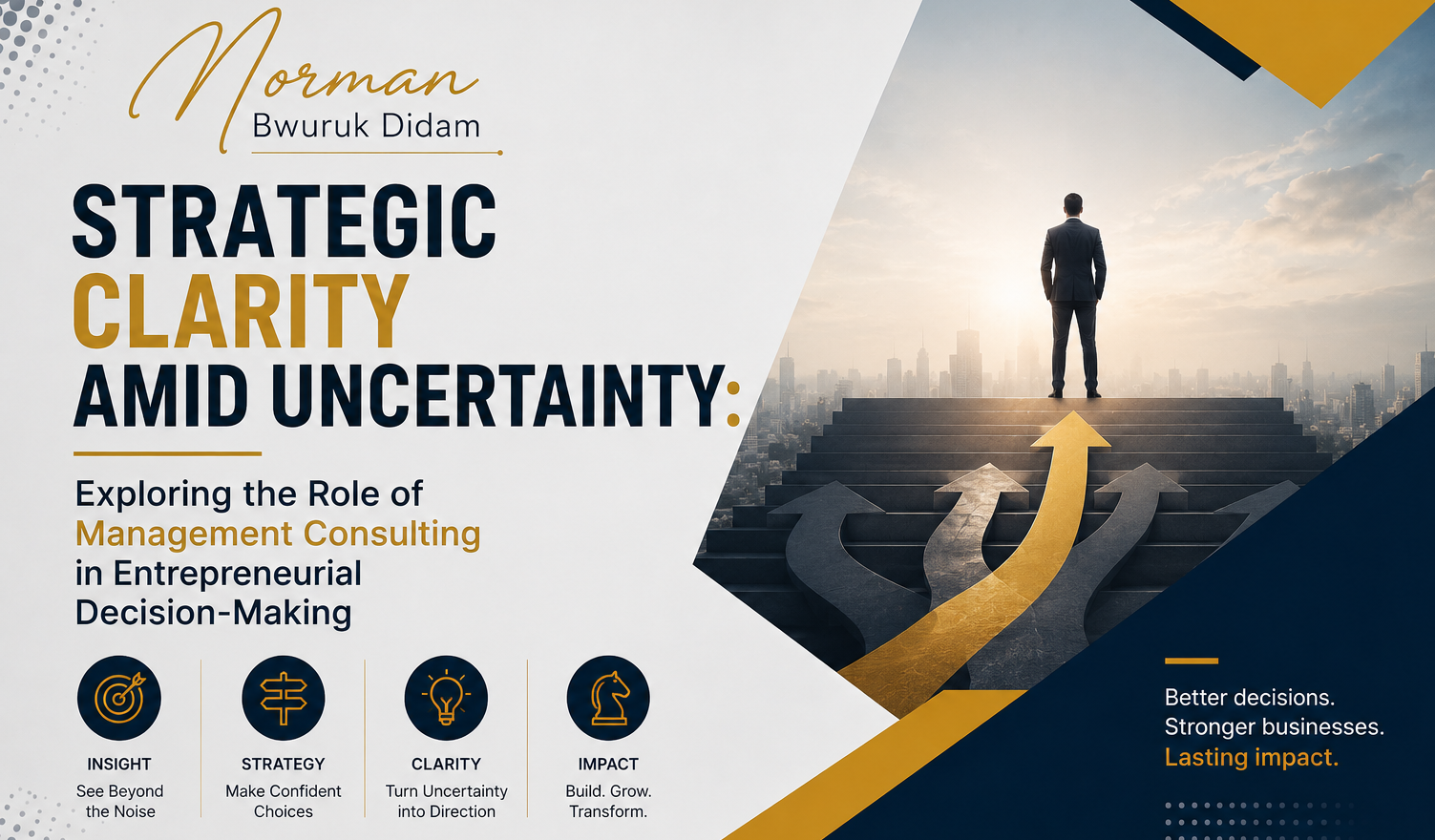
A promising opportunity can arrive without enough information, growth can create as many questions as it answers, capital can be available, yet the direction in which it should be deployed may remain unclear. Even experience, valuable as it is, may not account for every variable in a changing market.
Uncertainty is therefore not necessarily a weakness in entrepreneurship. It is part of the environment in which decisions are made.
This is where management consulting can assume a more interesting role. Rather than simply supplying answers, it can create the space to examine the quality of the questions, the assumptions behind them and the consequences attached to different choices.
For Norman Bwuruk Didam, whose experience spans entrepreneurship, investment, technology and real estate, this distinction offers a practical way of looking at strategic decision-making: clarity does not require certainty.
It requires a better understanding of what is known, what is uncertain and what deserves closer examination.
The Problem Beneath the Problem
Entrepreneurs are often presented with decisions in their simplest form:
Should we expand?
Should we invest?
Should we introduce a new product?
Should we enter another market?
Yet the visible question is not always the real one.
Expansion, for example, may not be the answer to slow growth, a new technology may not resolve an operational weakness, also Additional capital may not correct an inefficient business model.
Good strategic thinking begins by slowing down the rush towards a solution.
What is actually happening?
That question can be more valuable than an immediate recommendation.
Management consulting can help create this distinction by bringing structure to complex business problems—separating symptoms from causes, assumptions from evidence and attractive possibilities from commercially realistic ones.
Experience Matters. So Does Distance.
Entrepreneurial instinct should not be discarded.
Experience can reveal patterns that formal analysis may overlook. Business owners often understand their customers, markets and operating realities in ways that cannot be fully captured by data.
But proximity has another side.
The closer an entrepreneur becomes to a business, the easier it can be to accept familiar assumptions without revisiting them. Thus, an external perspective can introduce useful distance not because the consultant necessarily knows more about the business than its owner, but because an independent voice can ask questions without being attached to the answer.
That can make consulting less about telling an entrepreneur what to do and more about helping the entrepreneur see the decision from another angle.
Clarity Is Not the Same as Prediction
Strategic planning becomes fragile when it assumes that the future will behave exactly as expected.
Markets change, costs move, customers adapt, competitors respond, regulation evolves, and technology can alter an industry faster than a conventional five-year plan anticipates. Strategic clarity therefore may not come from predicting the future with precision. It can come from understanding the conditions under which a strategy makes sense and recognising what could cause that strategy to change.
This introduces a more flexible question:
If our assumptions change, what changes with them?
That question turns strategy from a static document into a continuing process of judgement.
When Opportunity Meets Capacity
An opportunity can be genuine and still be wrong for a particular business at a particular time.
A growing market may require more working capital than an organisation can comfortably provide, expansion may expose weaknesses in management systems, a new product may create demand that the existing operation cannot reliably fulfil. Hence, the strategic issue is therefore not simply whether an opportunity exists. It is whether the organisation has the capacity, resources and timing to pursue it responsibly.
Management consulting can help bring those considerations together, examining opportunity alongside financial position, operational capability, market conditions and execution requirements.
The result is not certainty.
It is perspective.
In another light, most Businesses now have access to an extraordinary amount of information.
Sales figures, customer behaviour, financial reports, inventory records and digital analytics can all contribute to decision-making. Yet more information does not automatically produce better judgement. The challenge is often knowing what matters.
Management consulting can help translate information into questions that management can actually act upon. The objective is not simply to have more data, it is to understand what the data is saying about the decision at hand.
The Nigerian Context Cannot Be an Afterthought
In most cases, strategy does not exist in a vacuum.
For Nigerian entrepreneurs, decisions can be shaped by financing conditions, infrastructure, regulation, supply chains, consumer behaviour, currency movements and differences in market maturity.
Even within Nigeria, circumstances vary considerably across sectors and locations.
A strategy relevant to a technology company in Abuja may require a different interpretation for a manufacturing business in Lagos or a property enterprise operating in another market.
This makes context essential.
The strongest strategic framework is not necessarily the most sophisticated one on paper. It may be the one that can withstand the realities of the environment in which it must operate.
Simultaneously, business risk can emerge through customer concentration, supplier dependency, operational disruption, cybersecurity exposure, weak cash flow, regulatory changes or excessive expansion.
The more useful question may be:
Which risks are we consciously accepting, which can be reduced, and which could materially change the decision?
That distinction can turn risk from an abstract warning into part of strategic judgement.
The Consultant Advises. The Entrepreneur Decides.
There is an important boundary in management consulting.
A consultant can provide analysis, challenge assumptions, develop scenarios and offer recommendations. But responsibility ultimately remains with the entrepreneur. That is why the most valuable consulting relationship may be collaborative.
The consultant brings structure and perspective, while the entrepreneur brings experience, context and ownership. Neither replaces the other.
Together, they can create a more disciplined environment for making difficult choices.
Strategic Clarity Amid Uncertainty
Norman Bwuruk Didam’s entrepreneurial perspective provides an interesting lens through which to view this relationship.
Across technology, real estate, investment and business, opportunities rarely exist independently of constraints. Capital nay have alternatives, timing matters, execution matters, market conditions matter, and decisions often have consequences beyond the immediate transaction.
Management consulting can therefore be viewed less as a mechanism for finding perfect answers and more as a discipline for making sense of imperfect information. That may be its more enduring value.
Strategic clarity does not mean knowing precisely what tomorrow will bring. Rather, it means understanding the direction being considered, the reasoning behind it, the risks surrounding it and the signals that may require a change of course.
In an uncertain business environment, that distinction can be significant.
The goal is not to make uncertainty disappear. It is to make better decisions while uncertainty remains.
Frequently Asked Questions
- What is strategic clarity amid uncertainty?
Strategic clarity is the ability to understand an organisation’s objectives, choices, assumptions, risks and priorities even when future conditions cannot be predicted with certainty.
- How can management consulting support entrepreneurs?
Management consulting can provide structured analysis, independent perspective and strategic frameworks that help entrepreneurs examine complex decisions and evaluate competing options.
- Why is context important in Nigerian business strategy?
Business decisions in Nigeria can be influenced by financing, infrastructure, regulation, consumer behaviour, supply chains and market conditions. Strategic recommendations may therefore need to reflect the realities of the specific business and sector.
- When might an entrepreneur need a management consultant?
Consulting may be useful when a business is considering expansion, entering a new market, committing significant capital, addressing persistent challenges or evaluating several strategic alternatives.