
Setting the Context
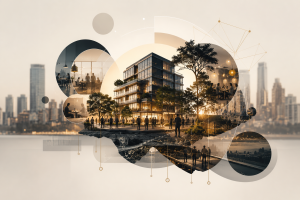
Every city may possess buildings that command attention, yet only a select few continue to command relevance long after their architectural novelty has faded. Their distinction is rarely explained by height, aesthetics, construction cost, or engineering sophistication alone. Instead, their enduring influence often emerges from something less immediately visible but considerably more valuable, such as the economic, commercial, and social ecosystems that gradually develop around them.
In contemporary real estate, the conversation surrounding value appears to be evolving. While architectural excellence remains an important expression of vision and craftsmanship, it may no longer represent the most enduring measure of a property’s significance. Increasingly, investors, developers, institutional stakeholders, and advisory professionals are looking beyond the building itself to understand the wider network of activity it has the potential to sustain.
A development that consistently attracts enterprise, encourages collaboration, supports local businesses, enhances surrounding land values, and contributes to the long-term vitality of its environment may ultimately outperform one whose primary distinction lies in its visual appeal. In such instances, the building functions less as a standalone asset and more as an economic platform-one capable of generating opportunities that extend well beyond its physical boundaries.
This distinction is becoming increasingly important in an era where cities compete not merely through infrastructure, but through their ability to cultivate resilient commercial ecosystems. Consequently, some of the most valuable real estate assets may derive their greatest strength not from what they are built with, but from what they continue to make possible.
Understanding this shift requires a broader definition of value-one that recognizes buildings not simply as physical investments, but as long-term participants in economic development.
When Buildings Become Platforms Rather Than Products
Conventional real estate analysis often begins with measurable attributes including location, design quality, floor area, construction standards, occupancy rates, and market value. While these indicators remain fundamental, they seldom explain why certain developments continue to outperform comparable assets over several decades.
Their sustained relevance frequently stems from an entirely different characteristic.
Rather than functioning solely as completed construction projects, they evolve into platforms upon which commerce, relationships, innovation, and investment continuously emerge.
Within these environments, businesses discover customers, entrepreneurs encounter opportunity, professionals establish networks, institutions form partnerships, and communities develop a shared economic identity. The physical structure provides the setting, but it is the ecosystem that generates enduring value.
In this context, architecture introduces the conversation; the surrounding ecosystem often determines how long the conversation continues.
The Compounding Nature of Economic Ecosystems
One of the more remarkable characteristics of successful developments is that their influence rarely remains confined to the boundaries of the property itself.
A well-conceived commercial development may stimulate demand for hospitality services, financial institutions, logistics providers, professional consultancies, retail businesses, transportation networks, and digital infrastructure. Residential developments frequently encourage investment in healthcare, education, recreation, security, and essential public services.
These relationships are seldom accidental.
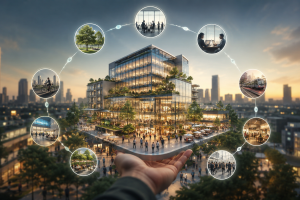
They represent a gradual process of economic compounding, where each successful activity creates conditions for additional investment, increased employment, stronger consumer confidence, and expanding commercial participation.
Over time, the surrounding ecosystem may become significantly more valuable than the original physical asset that initiated it.
This may explain why certain developments continue to appreciate in strategic importance long after construction has concluded.
The Invisible Infrastructure That Could Determine Long-Term Value
Most times, not every component of a valuable real estate asset appears on an architectural drawing.
Driven by considerations including; Trust, Accessibility, Business confidence, Institutional presence, Connectivity, Talent attraction, Consumer behaviour, and Entrepreneurial activity among others.
These largely intangible factors frequently exert greater influence on long-term asset performance than aesthetic enhancements alone.
Developments that consistently attract capable businesses, retain quality tenants, encourage repeat investment, and maintain strong public engagement often create an invisible infrastructure of confidence.
That confidence becomes self-reinforcing.
As more organizations choose to participate within the ecosystem, additional investment tends to follow, strengthening both the immediate development and its surrounding economic environment.
In many respects, confidence becomes an appreciating asset in its own right.
Designing for Adaptability Rather Than Permanence
One of the defining characteristics of resilient real estate is not its resistance to change, but its capacity to accommodate change. Markets evolve, Industries transform, Technology alters consumer expectations, Demographic priorities shift.
Buildings that remain commercially relevant through these transitions often possess a level of strategic flexibility that extends beyond architecture, Flexible workspaces, Integrated mixed-use environments, digitally enabled infrastructure, public gathering spaces, Walkable commercial districts, Sustainable operational systems. These features do more than improve user experience. They enable developments to respond to changing patterns of commerce without losing economic relevance.
In an increasingly dynamic global economy, adaptability may prove to be one of the most valuable forms of long-term asset preservation.
Commerce Flourishes Where Communities Find Reasons to Return
The most successful developments rarely depend upon constant marketing to remain active. Perhaps most evident in the fact that people return because the environment continues to offer value, Employees return because businesses continue to grow, Consumers return because experiences remain relevant, Investors return because confidence continues to strengthen, Communities return because the development has become integrated into everyday economic and social life.
This cycle creates momentum.
Rather than relying solely upon occupancy, successful buildings encourage recurring participation.
Over time, repeated participation often produces stronger commercial resilience than architectural distinction alone.
Buildings may attract visitors, while Ecosystems encourage permanence.
The Advisory Responsibility in Shaping Economic Legacy
Real estate advisory extends well beyond recommending locations or evaluating financial returns.
Its broader responsibility may involve helping investors understand how individual developments interact with wider economic systems.
Every strategic decision, notably land acquisition and master planning to tenant mix, infrastructure integration, mobility planning, sustainability initiatives, and commercial positioning has the potential to influence the quality of the ecosystem that eventually emerges.
This perspective encourages longer investment horizons.
Rather than asking how quickly a development can become occupied, it asks whether the development possesses the characteristics required to remain economically indispensable twenty or thirty years into the future.
That question may ultimately prove more valuable than any short-term performance projection.
Final Reflections
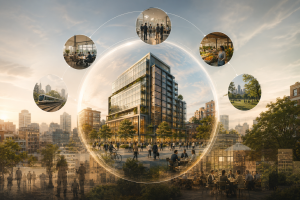
Perhaps the future of real estate excellence will be defined less by the visual prominence of individual buildings and more by the enduring prosperity they enable around them.
Buildings will continue to shape skylines.
Exceptional architecture will continue to inspire.
Engineering innovation will continue to advance.
Yet the developments that leave the deepest economic imprint may ultimately be those that create conditions in which commerce expands naturally, communities mature sustainably, investment compounds consistently, and opportunity becomes increasingly accessible across generations.
Their influence extends beyond ownership, Beyond occupancy, and beyond physical construction. They become participants in the economic evolution of the cities they inhabit.
In the years ahead, this may represent one of the most consequential shifts in real estate thinking.
The true value of a building may not be found solely in what stands upon the land, but in the lasting economic ecosystem it quietly enables long after construction has been completed.