
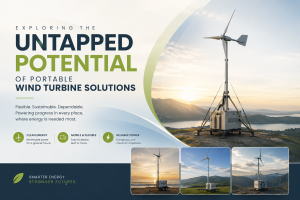
Energy has become one of the most essential foundations of modern life. It powers homes, businesses, industries, healthcare facilities, educational institutions, transportation networks, and the digital technologies that increasingly shape how societies function and economies grow. As demand for reliable electricity continues to rise, conversations around renewable energy, energy resilience, and sustainable power solutions are becoming increasingly important for governments, businesses, and communities alike.
Within this broader energy transition, attention has largely focused on technologies such as solar power, hydroelectricity, and utility-scale wind farms because of their ability to generate electricity on a significant scale. These investments continue to play an important role in expanding access to clean energy and supporting long-term sustainability goals. However, they also highlight an equally important question: how can renewable energy become more accessible in locations where permanent infrastructure may not always be practical or immediately available?
Norman Bwuruk Didam observes that this question is encouraging greater interest in localized renewable energy solutions designed to generate electricity closer to where it is needed. Among these emerging technologies are portable wind turbine solutions. These technologies are not intended to replicate commercial wind farms. Rather, they have been developed to address different operational needs, particularly in situations where flexibility, mobility, and localized power generation may be more valuable than scale alone.
Understanding portable wind turbines, how they work, and where they can be deployed is valuable-not only for professionals in the renewable energy sector, but also for businesses, educational institutions, humanitarian organizations, policymakers, investors, and individuals exploring innovative clean energy technologies. As interest in decentralized energy systems continues to grow, these technologies may offer practical opportunities to strengthen energy resilience and expand access to renewable electricity across diverse environments.
Understanding Portable Wind Turbines
Simply put, a portable wind turbine is a wind-powered electricity generation system designed to be transported and deployed with relative ease. Unlike conventional wind turbines, which are permanently installed on reinforced foundations and connected to electricity transmission networks, portable systems are generally intended for temporary, semi-permanent, or mobile applications. Depending on their design, they may be assembled and dismantled repeatedly, making them suitable for locations where constructing permanent energy infrastructure may not be practical.
Like all wind turbines, portable models operate on a relatively straightforward principle. As wind flows across specially designed blades, it causes them to rotate. This rotational movement drives a generator that converts the wind’s kinetic energy into electrical energy. That electricity can then be used immediately to power equipment, stored in battery systems for later use, or integrated with other renewable energy technologies depending on the requirements of the installation.
While the scientific principle is consistent across most wind turbines, portable models are often designed with mobility in mind. Manufacturers may use lightweight materials, modular towers, foldable components, and simplified installation systems that enable quicker deployment than conventional utility-scale turbines. These design considerations allow users to relocate the systems whenever operational requirements change.
Understanding Capacity: Matching Energy Needs to the Right System
Portable wind turbines are available in a wide range of sizes and power ratings because energy requirements vary significantly across different users and applications. Depending on their intended purpose and design, commercially available systems may range from approximately 500 watts (W) to 500 kilowatts (kW), although higher-capacity models are generally classified as transportable or modular systems rather than compact portable units.
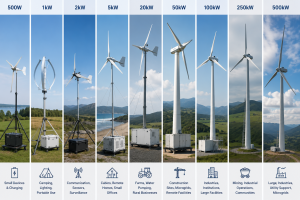
This broad range reflects the versatility of the technology rather than a single standard design. Lower-capacity systems may be suitable for charging batteries, powering communication equipment, lighting, environmental monitoring devices, or other essential electronics. As capacity increases, portable wind turbines may be configured to support homes, offices, telecommunications infrastructure, agricultural operations, temporary facilities, construction sites, humanitarian missions, and other locations requiring a more substantial and dependable electricity supply.
The appropriate system is therefore determined less by its physical size and more by the amount of electricity required for the intended application. Rather than asking which turbine is the largest, it is often more practical to consider which capacity best aligns with the energy demands, operating conditions, and deployment environment of a particular project. This diversity in capacity is one of the characteristics that allows portable wind turbines to serve a wide variety of residential, commercial, institutional, and industrial applications.
Where Clean Energy Meets Everyday Living
One of the more interesting aspects of portable wind technology is the diversity of environments in which it may be deployed.
For example, humanitarian organizations responding to natural disasters may require temporary electricity for communication systems, medical equipment, lighting, or water purification. Construction companies operating in remote locations may need power before permanent electrical infrastructure is established. Agricultural operations may benefit from electricity for irrigation systems, livestock monitoring, or seasonal activities. Researchers conducting environmental studies often require dependable power for monitoring equipment in isolated locations.
Portable wind turbines may also support telecommunications infrastructure in rural communities, temporary outdoor events, border surveillance operations, eco-tourism facilities, educational field projects, and emergency response centers.
Not every application will be suitable for wind energy alone. Nevertheless, the technology offers an additional option in situations where extending conventional electricity infrastructure may be technically difficult, financially demanding, or unnecessary for temporary operations.
Beyond industrial and remote applications, portable wind turbines may also present interesting possibilities for residential and small commercial environments, particularly as interest in decentralized energy solutions continues to grow.
Mr. Norman notes that these systems are likely to meet the electricity demand of appropriately sized models such as outdoor lighting, security systems, internet and communication equipment, home offices, battery storage systems, or other essential appliances, depending on local wind conditions and overall energy requirements.
In areas where electricity supply may be inconsistent or where property owners are exploring complementary renewable energy options, portable wind turbines could serve as part of a broader hybrid energy system alongside solar panels and battery storage. Such an approach is not intended to replace conventional grid electricity in every circumstance but may enhance energy resilience, provide an additional source of renewable power, and offer greater flexibility during periods of increased demand or temporary power interruptions.
As residential and commercial buildings continue evolving towards smarter and more diversified energy management, portable wind technology may gradually become one of several practical tools available for improving localized energy generation.
Understanding Both the Opportunities and the Limitations
Like every energy technology, portable wind turbines offer both advantages and practical limitations.
Their mobility allows electricity generation in locations where permanent infrastructure may not be feasible. They may contribute to reducing dependence on fuel-powered generators in some situations and can support greater operational flexibility for organizations working in remote environments.
However, their effectiveness remains closely linked to local wind conditions. Areas with consistently low wind speeds may not generate sufficient electricity to justify installation. Likewise, poor site selection, inadequate maintenance, or unrealistic expectations regarding electricity demand can reduce system performance.
Recognizing these limitations does not diminish the technology’s value. Rather, it encourages more informed decision-making by matching the appropriate technology to the appropriate application.
Looking Beyond Scale
Norman Bwuruk Didam suggests that one of the more interesting lessons offered by portable wind turbines is that innovation is not always measured by size. In many cases, technological progress also involves making existing technologies more adaptable, more accessible, and better suited to a wider range of practical needs.
Portable wind turbines are unlikely to replace utility-scale wind farms, nor were they developed with that objective in mind. Instead, they represent a complementary approach to renewable energy—one that focuses on mobility, localized electricity generation, and operational flexibility.
As businesses, governments, humanitarian organizations, educational institutions, and communities continue exploring more resilient approaches to energy access, portable wind turbines may gradually occupy a more visible place within the broader renewable energy landscape. Their future significance may depend less on competing with large infrastructure projects and more on their ability to provide practical solutions where conventional systems are either unavailable or not the most suitable option.
For many people, portable wind turbines remain a relatively unfamiliar technology. Yet understanding their purpose, capabilities, and limitations offers a valuable reminder that the future of renewable energy is likely to be shaped not only by larger infrastructure, but also by smarter, more adaptable solutions capable of meeting diverse energy needs across an increasingly dynamic world.
Frequently Asked Questions (FAQs)
1. What is a portable wind turbine?
A portable wind turbine is a movable wind-powered system designed to generate electricity in temporary, remote, or off-grid locations.
2. How do portable wind turbines generate electricity?
They convert the kinetic energy of wind into electrical energy through rotating blades connected to a generator.
3. Can portable wind turbines power homes or offices?
Yes, depending on their capacity and wind conditions, they can support selected household or office electrical loads or complement existing power systems.
4. Where are portable wind turbines commonly used?
They are used in homes, farms, construction sites, telecommunications, disaster response, research stations, and other remote or temporary locations.
5. Can portable wind turbines replace conventional power sources?
Not entirely. They are generally designed to complement grid electricity or other renewable energy systems, rather than replace them.