
The reality may be considerably more nuanced.
For many Nigerian businesses, the more difficult question is not just which technology to buy, but which problem is worth solving, which process needs to change and how much organizational capacity exists to sustain that change.
This distinction places entrepreneurs in an interesting position. Entrepreneurs who have spent years navigating uncertainty, identifying market gaps and adapting business models may have a role that extends beyond introducing technology. They can, in some circumstances, help businesses interpret technological possibilities within the realities of their markets, people, customers and operating environments.
Nigeria’s digital economy itself reflects this complexity. The World Bank’s Nigeria Digital Economy Diagnostic identified digital infrastructure, digital platforms, digital financial services, digital entrepreneurship and digital skills as interconnected foundations of digital development, while also noting significant gaps and uneven access. (World Bank)
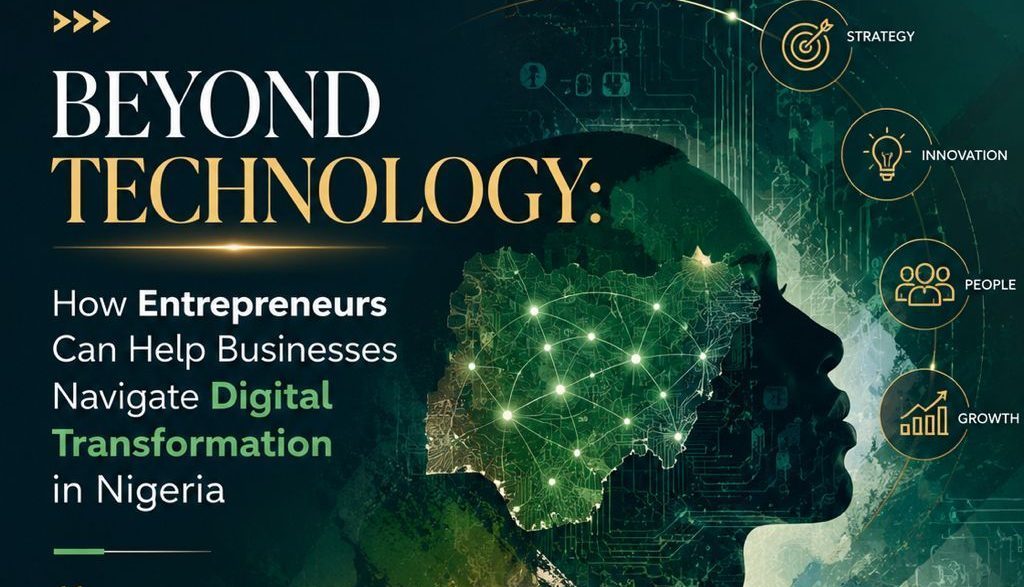
Digital transformation, therefore, may be better understood not as a technology project but as a business adaptation process in which technology becomes one of several instruments of change.
Technology Is Only One Part of the Transformation
There is a temptation to equate digital transformation with digital adoption.
The distinction matters.
Digital adoption might involve introducing accounting software, deploying a customer relationship management system, creating an e-commerce platform or replacing manual documentation with digital records. These interventions can be useful. Yet their value may depend on what happens around them.
A company could purchase sophisticated enterprise software and still operate inefficiently if its internal processes remain poorly defined, a retailer could establish an online store without resolving inventory inconsistencies, a professional services firm could introduce collaboration platforms while retaining approval structures that unnecessarily delay decisions.
In such cases, technology may simply make an existing problem more digital.
This is where entrepreneurial thinking can become relevant.
Entrepreneurs frequently work from a problem-first perspective. Their instinct is often to ask what customers need, where friction exists, what resources are available and whether a proposed solution can create sufficient value. That mindset can complement technical expertise when businesses are considering digital transformation.
The question becomes less “What technology should this company adopt?” and more:
“What should this business do differently, and where might technology make that difference practical?”
That shift can produce a more disciplined approach to digital investment.
The Nigerian Context Requires More Than Imported Technology Models
Digital transformation strategies developed in highly digitized markets cannot necessarily be transferred wholesale into Nigeria.
The operating environment is different.
Businesses may encounter varying levels of connectivity, infrastructure reliability, digital skills, financing, cybersecurity awareness and access to suitable devices. Customer behavior can also differ substantially between sectors and locations.
The World Bank has previously highlighted uneven digital access in Nigeria, including differences in broadband availability and digital skills, while identifying the business environment, financing and market access as considerations for digital entrepreneurship. (World Bank)
These realities suggest that transformation strategies may need to be contextual rather than fashionable.
For one organization, the priority might be digitizing financial records. For another, it could be improving inventory visibility. A third business may gain more from strengthening cybersecurity, establishing reliable backups or improving customer communication than from introducing an advanced artificial-intelligence system.
The sophistication of a digital strategy, therefore, should not necessarily be measured by the sophistication of the technology involved. Sometimes, the most meaningful intervention may be relatively simple.
Where Entrepreneurs May Become Strategic Intermediaries
Entrepreneurs who understand both business operations and technology can potentially occupy a space between the technical provider and the business owner.
That intermediary role can be valuable because technology vendors naturally focus on their solutions, while business owners may understandably focus on immediate operational concerns.
An entrepreneur with broader commercial experience may help connect the two.
- Identifying the Real Business Problem
Before recommending a platform, entrepreneurs can examine where the business is experiencing friction.
Is information difficult to retrieve?
Are customers waiting too long for responses?
Are sales records fragmented?
Does management lack reliable visibility into inventory?
Are employees repeatedly performing tasks that could reasonably be streamlined?
Is the organization collecting data without actually using it?
These questions can reveal whether technology is genuinely required—or whether the underlying issue is organizational.
This is an important distinction because not every operational weakness is a technology problem.
Sometimes the solution may be a clearer workflow, better delegation, staff training or stronger management controls.
- Connecting Technology with Commercial Objectives
Digital transformation becomes more meaningful when technology can be connected to a measurable business objective.
An entrepreneur might therefore encourage a company to evaluate a proposed digital investment through questions such as:
- What business outcome are we pursuing?
- What process will change?
- Who will use the system?
- What additional costs will emerge?
- What skills will employees require?
- How will performance be measured?
- What happens if the technology fails?
- How will customer and business data be protected?
This approach can help prevent technology spending from becoming an end in itself.
A cloud platform, for example, may improve accessibility and collaboration for one organization while creating unnecessary complexity for another if its data governance, connectivity, user requirements and operational needs have not been considered.
The technology is not automatically valuable simply because it is modern.
Its value emerges from fit.
- Helping Businesses Think in Stages
One reason digital transformation can become intimidating is the tendency to imagine it as a single, large-scale project.
For many businesses, a phased approach may be more practical.
A company could begin by mapping its processes, digitizing critical records, improving data management and strengthening basic cybersecurity. It could subsequently introduce more sophisticated analytics, automation or AI applications once the underlying information and processes are sufficiently mature.
This staged approach does not mean that every business should follow the same sequence. Rather, it recognizes that digital maturity tends to develop unevenly.
A smaller enterprise may not need the same technological architecture as a multinational corporation. The objective may be to build appropriate digital capability, rather than to imitate the technology stack of a larger organization.
From Digital Tools to Organizational Capability
Perhaps the more important question is what happens after technology has been installed.
Digital transformation requires people. Employees need to understand new systems, managers need to adjust workflows, leadership may need to reconsider how decisions are made, and customers may need to become familiar with new channels.
Without these adaptations, technology can remain underutilized.
This is particularly important in environments where digital skills are unevenly distributed. The World Bank’s assessment of Nigeria’s digital economy has long identified skills as one of the foundational elements of digital development. (World Bank)
Entrepreneurs can contribute by helping businesses view training as part of the transformation itself rather than as an afterthought.
A new system may be technically functional on the day it is installed. That does not necessarily mean the organization is ready to derive sustained value from it.
The Entrepreneur as a Translator of Change
There is another role entrepreneurs may play: translation.
Digital transformation introduces terminology that can become unnecessarily complex—cloud computing, artificial intelligence, automation, APIs, cybersecurity, data analytics, digital twins and numerous other concepts.
Business owners do not necessarily need to become specialists in all these fields.
They need to understand what the technologies could mean for their particular operations.
An entrepreneur who can translate technical possibilities into commercial consequences may therefore become useful as an adviser, consultant, technology partner or implementation intermediary.
Instead of saying:
“Your company needs an AI-powered platform.”
The conversation could become:
“There is a repetitive customer-service process that consumes staff time. Let us examine whether automation could handle part of it without reducing service quality.”
The second approach begins with the business problem.
That difference may appear small, but it changes the nature of the conversation.
Digital Transformation May Also Create New Risks
A balanced discussion of digital transformation cannot focus exclusively on opportunity.
Digital systems introduce dependencies.
Cybersecurity becomes increasingly relevant as businesses digitize information and connect more processes. Data protection, access management, system reliability, vendor dependence, employee training and business continuity can become part of the transformation equation.
There is also the question of cost.
Software subscriptions, infrastructure, implementation, maintenance, cybersecurity, training and upgrades can collectively create a larger financial commitment than the initial purchase price suggests.
For this reason, entrepreneurs advising businesses may need to think beyond acquisition.
The relevant question is not simply whether a business can afford a technology today, but whether it can operate, maintain and govern it over time.
Why Digital Transformation May Need Entrepreneurial Thinking
Nigeria’s evolving digital policy environment indicates that digitalization is increasingly being considered at an institutional level. In August 2026, for example, the Federal Government unveiled a National Digital Cloud Policy intended to provide a framework for cloud computing and data infrastructure, with objectives including investment, digital infrastructure capacity and government transformation. (Federal Ministry of Communications)
Such developments can create new possibilities for businesses, but policy direction alone does not determine commercial outcomes.
The private sector still has to decide what to adopt, how to adopt it and whether the resulting investment makes economic and operational sense.
This is where entrepreneurial thinking can complement technological expertise.
Entrepreneurs are accustomed to making decisions under imperfect information. They often evaluate opportunities against available capital, customer behavior, competition, timing and risk. Those same considerations are relevant when businesses evaluate digital transformation.
Technology specialists may know how to build or deploy a system.
Entrepreneurs can help ask whether the system should be built or deployed in the first place.
The Opportunity for Nigerian Entrepreneurs
There is consequently an opportunity for Nigerian entrepreneurs to participate in digital transformation without necessarily becoming software developers or technology manufacturers.
Some may become consultants. Others may operate as systems integrators, technology resellers, implementation partners, business-process advisers or industry-specific solution providers.
Some may identify gaps between international technologies and local business requirements and develop services around those gaps.
The opportunity is potentially broad because Nigeria’s digital economy encompasses more than technology companies. The World Bank’s framework treats digital infrastructure, platforms, financial services, businesses and skills as interconnected components of the broader digital economy. (World Bank)
This means that entrepreneurial value can emerge at multiple points in the ecosystem.
The strongest opportunities may not always come from creating another technology product. They could also emerge from helping existing businesses understand, adapt and effectively use technologies that already exist.
A More Practical Definition of Digital Transformation
Perhaps digital transformation in Nigeria should not be defined simply as the process of moving from manual systems to digital ones.
A more useful interpretation may be:
the deliberate redesign of how a business operates, serves customers, uses information and makes decisions, with digital technologies employed where they can reasonably improve those outcomes.
The qualification matters.
Technology should serve the transformation—not just become the transformation.
This perspective also makes room for businesses at different stages of development. A small enterprise beginning with digital bookkeeping is not necessarily behind a larger organization implementing artificial intelligence. The two may simply be solving different problems at different levels of organizational maturity.
Progress should therefore be judged in relation to the business’s circumstances and objectives.
The Entrepreneurial Advantage May Be the Ability to See the Whole Picture
Digital transformation ultimately sits at the intersection of technology, people, processes, capital and strategy.
Entrepreneurs who can understand those intersections may have an increasingly relevant role in Nigeria’s evolving business environment.
Their contribution may not always be the technology itself; it may be the ability to ask better questions before the technology is purchased. It may be the discipline to challenge unnecessary complexity, It may be the commercial judgement to determine whether a digital investment aligns with the organization’s priorities, or it may simply be the willingness to recognize that transformation is rarely accomplished by software alone.
For Nigerian businesses, this broader perspective could become increasingly important as digital infrastructure, cloud services, artificial intelligence, financial technology and other digital capabilities continue to develop.
The central issue, however, is unlikely to be how quickly businesses can acquire new technologies.
It may be how intelligently they can integrate those technologies into the realities of the businesses they are trying to build.
And that is where the conversation moves beyond technology.
It becomes a conversation about entrepreneurship, judgement and the capacity to turn technological possibility into practical business value.