
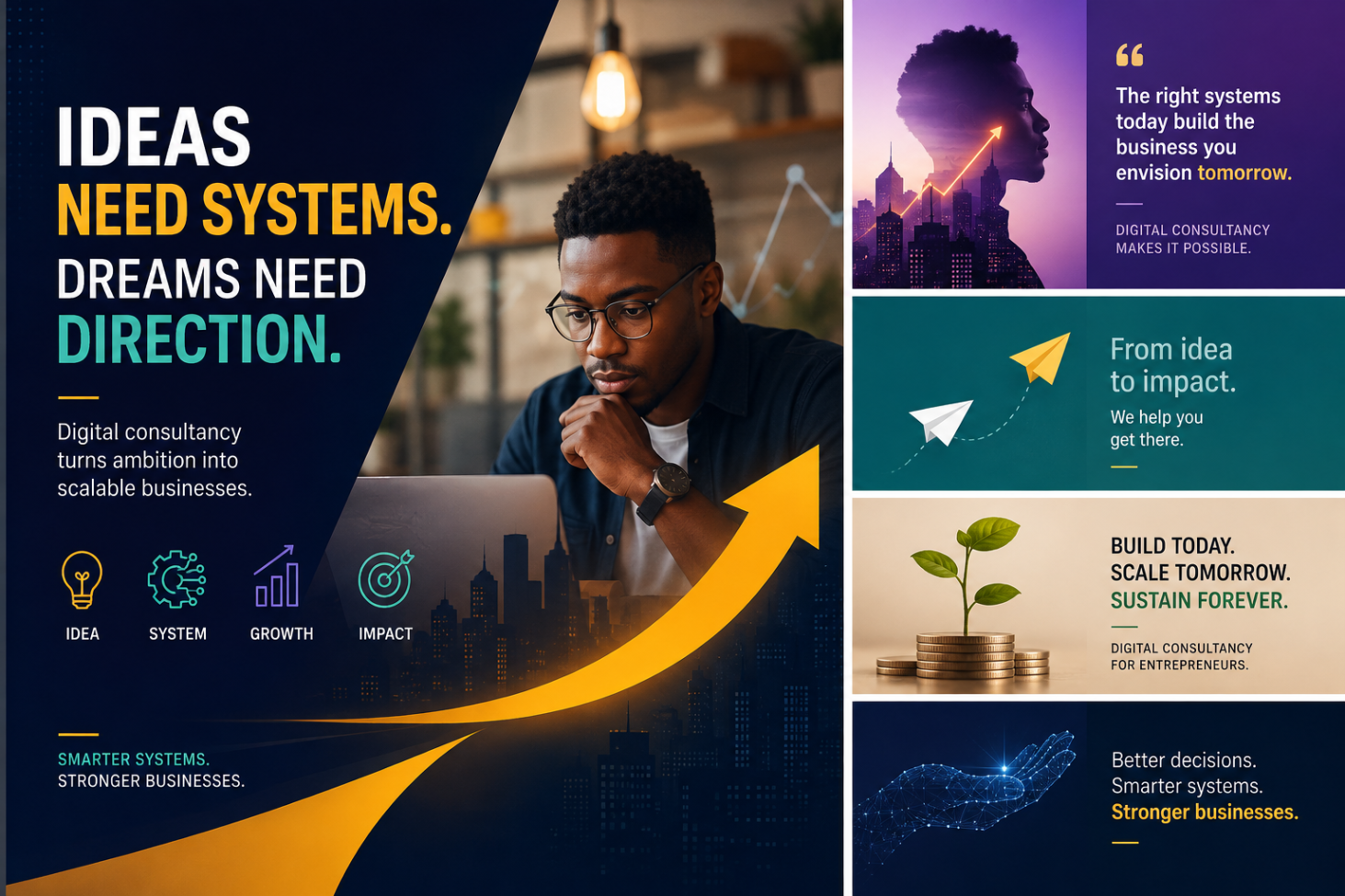
For many young entrepreneurs, this is where digital consultancy becomes important.
Digital consultancy is not simply about purchasing software, creating a website or moving a business onto social media. It is about understanding how digital systems can improve the way a business operates, serves customers, manages information and makes decisions.
The question, therefore, is not simply “What technology should I use?”
A more useful question is:
“What can my business do better if the right digital system is introduced?”
Digital Consultancy Starts with the Business
Technology should serve the business rather than become the business strategy.
A young entrepreneur may be spending hours recording transactions manually, responding individually to customers, tracking inventory through notebooks or spreadsheets, or storing important business information across personal phones and messaging platforms.
These methods may work at a very small scale. However, as customers and transactions increase, manual processes can create delays, errors, duplicated work and unnecessary dependence on the entrepreneur.
Digital consultancy helps businesses examine these processes and determine where a digital system can create practical value.
Moving From Manual Processes to Digital Systems
For a young business, manual processes can initially appear inexpensive. A notebook cost little, a spreadsheet may be sufficient, a founder can personally respond to customers and keep track of orders. The challenge emerges when the business begins to grow.
Consider a small business managing 20 customers manually. It may be manageable. At 200 or 2,000 customers, the same approach can become increasingly difficult to maintain.
A suitable digital system can help organize:
- Customer information
- Sales and transactions
- Inventory
- Financial records
- Orders and deliveries
- Employee responsibilities
- Customer communication
- Business reports
- Operational workflows
This does not mean every entrepreneur needs sophisticated enterprise software. In many cases, relatively simple and affordable digital tools can provide meaningful improvements.
The important consideration is whether the system is appropriate for the current stage of the business and capable of supporting its next stage of growth.
Turning an Idea into a Business Model
Digital consultancy can also play a role before a business becomes fully established.
An idea may appear promising, but entrepreneurs still need to understand the market, customer behavior, competing alternatives, pricing and the practical cost of delivering the proposed solution.
Digital platforms can make it easier to conduct research, test ideas, gather customer feedback and observe market behavior before committing substantial resources. This creates an opportunity for validation before expansion.
Instead of building extensively and hoping customers will come, entrepreneurs can use digital channels to learn what customers actually want and refine the business accordingly. The value is not in collecting endless digital data. It is in using relevant information to make better business decisions.
Building Systems Before the Business Becomes Complicated
Growth can expose weaknesses that were not visible when a business was small.
A founder who personally handles every enquiry may manage a small customer base. As demand increases, the same approach can become a bottleneck.
Likewise, manually recording every sale, following up with every customer or monitoring inventory without a structured system becomes increasingly difficult as operations expand. Digital systems can provide structure before these problems become overwhelming.
Customer relationship management, accounting platforms, inventory systems, cloud collaboration, automated notifications and workflow tools can help create processes that are repeatable rather than dependent entirely on the founder.
This is an important part of scalability.
Digital Consultancy Can Help Entrepreneurs Use Technology More Intentionally
Young entrepreneurs are often exposed to a wide range of technologies, platforms and digital services. The challenge is deciding what is actually necessary.
A business does not become more sophisticated simply because it uses more technology.
A practical digital roadmap may begin with:
- Digitizing essential records and information
- Organizing customers, sales and operations
- Reducing repetitive manual activities
- Introducing basic reporting and analytics
- Connecting systems as the business grows
- Adopting more advanced technology when there is a clear business case
This approach can help entrepreneurs avoid spending scarce resources on systems that are impressive but unnecessary.
Turning Digital Presence into Business Value
Many young Nigerian businesses already have a digital presence through WhatsApp, Instagram, websites, online marketplaces and other platforms.
But being visible online is different from having a digital business system.
A social media page may attract attention. A properly structured digital process can help convert that attention into enquiries, customer records, transactions, repeat business and useful information.
This means entrepreneurs should consider the complete customer journey:
Discovery → Enquiry → Purchase → Payment → Delivery → Follow-up → Repeat Business
Digital systems can help connect these stages, making the customer experience more consistent while giving the entrepreneur greater visibility into what is working.
Designing for Nigerian Business Realities
Connectivity, electricity, affordability, payment preferences, logistics, digital skills, cybersecurity and customer behaviour can all influence whether a technology is practical.
A system that works perfectly in another market may not necessarily be the best solution for a Nigerian business. For young entrepreneurs operating with limited resources, this makes simplicity, reliability and suitability particularly important.
The most advanced system is not always the most valuable. Sometimes, a simpler solution that employees can understand, customers can use and the business can afford to maintain is the better investment.
Digital Systems and Business Growth
Scalability is not simply about finding more customers. It is about being able to serve more customers without allowing costs, errors and operational complexity to grow uncontrollably.
Digital systems can support this by making information easier to access, reducing repetitive work, improving record-keeping and creating greater visibility across the business. They can also help an entrepreneur demonstrate that the business has structure.
Reliable financial records, customer information, sales history, inventory data and documented processes can become valuable when seeking partnerships, financing or institutional opportunities. Digital systems do not guarantee investment or growth. They simply create a stronger operational foundation from which growth can be pursued.
The Real Value of Digital Consultancy
The real value of digital consultancy is not necessarily in recommending the newest technology. It lies in helping entrepreneurs understand where digital systems can make a meaningful difference.
For a young Nigerian entrepreneur, this could mean replacing a paper-based process with a digital record, moving customer information into a structured system, automating a repetitive task, using data to understand purchasing behavior or creating a workflow that allows the business to operate more efficiently.
The entrepreneur can spend less time searching for information and repeating administrative tasks and more time focusing on customers, products, relationships and strategic decisions.
From Idea to Scalable Enterprise
There is a considerable distance between having a business idea and building an enterprise capable of sustained growth. Digital consultancy cannot eliminate the challenges of entrepreneurship. It cannot create market demand, replace sound management or guarantee profitability.
What it can do is help young entrepreneurs make better use of digital systems as they build.
The objective is not to create a business that simply looks digital.
It is to create one that is organized enough to grow, efficient enough to compete and adaptable enough to respond to change.
For young entrepreneurs in Nigeria, that distinction may become increasingly important.
The businesses that thrive may not necessarily be those with the most technology, but those that understand which technology solves a real problem, when to introduce it and how to make it work within the realities of the business.
In that sense, digital consultancy is not simply about taking an idea online.
It is about giving that idea the systems and structure it needs to become a business capable of going further.
About Norman Bwuruk Didam
Norman Bwuruk Didam is a philanthropist, investor, serial entrepreneur and business management consultant with more than 15 years of experience spanning technology, real estate and construction. He is the Founder and CEO of Technology House Limited, with professional interests spanning entrepreneurship, emerging technology, business strategy and sustainable growth.
Through his personal platform, Norman shares perspectives on technology, entrepreneurship, innovation, real estate, construction and business development, with an interest in how emerging solutions can be applied to practical opportunities in Africa.
Frequently Asked Questions
What is digital consultancy for young entrepreneurs?
Digital consultancy involves assessing how digital tools, systems and processes can help an entrepreneur improve operations, customer management, decision-making and business growth.
How can digital systems help a small business?
Digital systems can organize customer information, sales, financial records, inventory and workflows while reducing repetitive manual tasks and improving access to business information.
Do young entrepreneurs need expensive technology?
Not necessarily. The appropriate solution depends on the size, needs and stage of the business. Simple and affordable digital tools can often provide significant value before more advanced systems become necessary.
Why should entrepreneurs move away from manual processes?
Manual processes can become difficult to manage as transactions and customers increase. Digital systems can reduce errors, improve accessibility and allow certain processes to operate more consistently.
Can digital consultancy help a business scale?
Yes, when applied appropriately. Digital consultancy can help identify processes that need improvement, introduce suitable systems and create a stronger operational foundation for growth.