
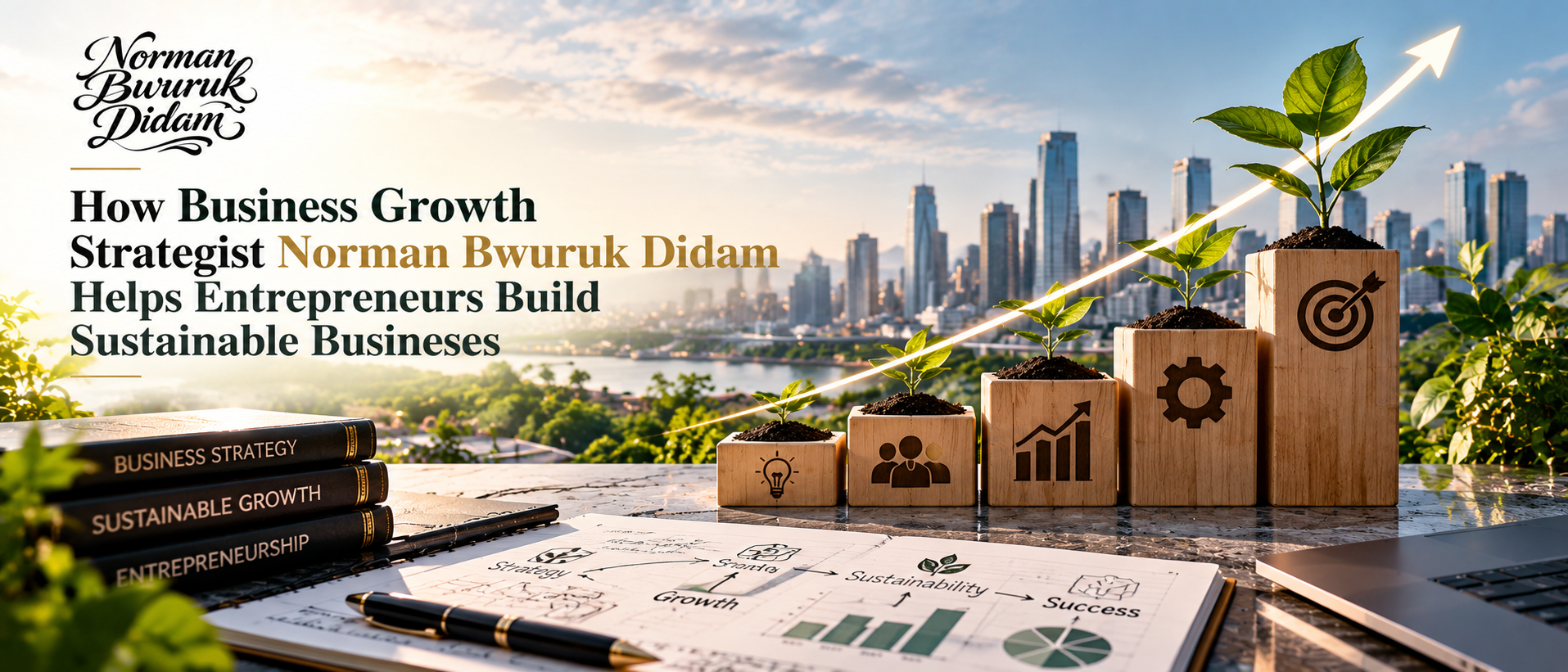
Business growth strategist Norman Bwuruk Didam approaches entrepreneurship from a broad business perspective shaped by experience across technology, real estate, construction, investment, and management consultancy. His professional work focuses on identifying opportunities, improving business performance, encouraging innovation, and helping organizations respond to changing market realities.
For entrepreneurs, sustainable growth is not simply about becoming larger. It involves creating systems, processes, and strategies that allow a business to remain competitive while generating long-term value. This article explores several principles that can help entrepreneurs build stronger and more sustainable businesses.
What Does Sustainable Business Growth Mean?
Sustainable business growth refers to the ability of a company to expand while maintaining financial stability, operational efficiency, customer value, and long-term relevance.
Rapid growth can sometimes create new problems if a business does not have the systems to support it. For example, increasing sales without adequate staff, technology, cash-flow management, or customer support can place pressure on the organization.
Sustainable growth generally requires a balance between:
- Revenue growth
- Cost management
- Customer satisfaction
- Operational efficiency
- Employee development
- Innovation
- Risk management
- Long-term planning
The objective is not simply to grow quickly. It is to build a business that can continue operating and adapting as conditions change.
Why Strategic Thinking Matters for Entrepreneurs
Entrepreneurs often make decisions while managing several responsibilities at once. They may be responsible for sales, employees, finances, operations, marketing, and customer relationships. This can make it difficult to step back and evaluate the business objectively.
Strategic thinking helps business owners understand where the company currently stands and where it needs to go. It can involve reviewing market conditions, identifying competitive advantages, assessing weaknesses, and determining which opportunities are worth pursuing. A structured approach can help entrepreneurs avoid making decisions based solely on short-term pressure.t.
How Can Entrepreneurs Build Sustainable Businesses?
1. Define a Clear Business Direction
A business needs a clear understanding of what it wants to achieve.
Entrepreneurs should establish:
- Short-term objectives
- Long-term goals
- Target customers
- Revenue objectives
- Market positioning
- Expansion priorities
Clear objectives make it easier to determine which activities deserve attention and investment. Without direction, businesses can spend resources on opportunities that do not contribute meaningfully to their long-term objectives.
2. Use Technology Strategically
Technology can support business growth, but adopting technology without a clear purpose may not create meaningful value. Entrepreneurs should first identify business problems before selecting digital solutions.
Technology may help businesses with:
- Customer relationship management
- Digital payments
- Data analysis
- Marketing
- Communication
- Process automation
- Inventory management
- Remote collaboration
Digital transformation is therefore not simply about purchasing software. It involves using technology to improve processes, customer experiences, decision-making, and overall business performance.
3. Develop Strong Financial Discipline
Financial management is another important component of sustainable growth. A business may generate significant revenue but still face financial difficulties if expenses, cash flow, debt, and investment are poorly managed.
Entrepreneurs should monitor:
- Revenue and expenses
- Cash flow
- Profit margins
- Business debt
- Operating costs
- Investment requirements
- Emergency reserves
Separating personal and business finances can also make financial performance easier to evaluate. Growth decisions should be based on realistic financial information rather than assumptions about future income.
4. Invest in People and Leadership
Employees play an important role in business performance. Entrepreneurs should therefore focus not only on recruiting capable people but also on developing their skills.
Leadership development can include:
- Training and professional development
- Clear responsibilities
- Performance measurement
- Effective communication
- Mentorship
- Team collaboration
A strong organizational culture can also encourage employees to contribute ideas and identify opportunities for improvement.
Building Sustainable Business Models
Sustainable growth requires more than increasing sales. Businesses also need systems that can support growth without creating unnecessary financial or operational pressure.
A sustainable business model should consider:
Customer value + efficient operations + financial discipline + adaptability + long-term strategy
Entrepreneurs should therefore examine whether their current business model can continue to perform as the company grows. Rapid expansion without appropriate systems can create cash-flow pressures, quality problems, staffing challenges, and operational inefficiencies. A measured approach allows entrepreneurs to strengthen their foundations before taking on additional complexity.
How Strategic Leadership Supports Sustainable Growth
Leadership has a direct influence on how effectively a business implements its strategy. Entrepreneurs need to communicate objectives clearly, establish accountability, develop their teams, and make decisions based on reliable information. Strategic leadership also requires understanding when to seek external expertise.
An objective perspective can help business owners identify challenges that may be difficult to recognize from inside the organization. By combining internal knowledge with external strategic insight, entrepreneurs can approach important decisions with greater clarity.
About Norman Bwuruk Didam
Norman Bwuruk Didam is a serial entrepreneur, investor, philanthropist, and business management consultant Nigeria with more than 15 years of experience in technology, real estate, and construction. He is the Founder and CEO of Technology House Limited. His expertise spans business development, property development, digital transformation, management consultancy, and innovation.
The leadership and technical experience of business growth strategist Norman Bwuruk Didam has contributed to more than 25 residential, commercial, and community infrastructure projects. In technology, he focuses on identifying emerging solutions and connecting global innovations with opportunities across African markets. Beyond business, his work includes philanthropy, mentorship, and entrepreneurial development. Through his platform, he shares practical insights on entrepreneurship, technology, real estate, construction, innovation, and sustainable business growth.
Final Note
Sustainable business growth requires more than increasing revenue. Entrepreneurs need a combination of strategic planning, customer understanding, financial discipline, efficient systems, technology, leadership, and continuous innovation.
The experience of business growth strategist Norman Bwuruk Didam across entrepreneurship, technology, real estate, construction, investment, and management consultancy provides a broad perspective on these areas. His work also highlights the importance of connecting innovation with practical business needs and long-term value creation.
Entrepreneurs and business leaders looking for further insights into business strategy, entrepreneurship, technology, innovation, and sustainable growth can explore the personal blog site of Norman Bwuruk Didam for additional perspectives and resources. Visit the official website now to learn more.
“`html
Frequently Asked Questions
- What is a business growth strategist?
A business growth strategist helps entrepreneurs identify opportunities, improve business performance, develop growth plans, and address challenges that may affect long-term expansion.
- How can entrepreneurs achieve sustainable business growth?
Entrepreneurs can focus on clear objectives, customer needs, financial discipline, efficient systems, technology, employee development, and continuous improvement.
- Why is technology important for business growth?
Technology can improve operational efficiency, customer communication, data management, automation, and decision-making when it is aligned with genuine business objectives.
- What role does financial management play in sustainable growth?
Financial management helps businesses monitor cash flow, expenses, profitability, investment needs, and financial risks. It supports more informed expansion decisions.
- How can entrepreneurs prepare their businesses for future changes?
Businesses can monitor market trends, invest in employee development, adopt useful technologies, understand customer expectations, and remain flexible enough to adjust their strategies.