
Beyond Connectivity: Why Digital Understanding Matters More Than Internet Access
The modern world has never been more connected. Across crowded cities and remote communities alike, billions of people now carry the internet in their pockets. Fibre-optic networks stretch across nations, Satellites orbit the earth transmitting signals at extraordinary speed, and Smartphones illuminate homes, classrooms, businesses, and marketplaces across continents.
By every visible metric, humanity appears digitally connected.
Yet, beneath this remarkable technological expansion lies a quieter and more consequential reality: connection alone does not equal understanding.

A person may spend hours online every day and still remain disconnected from meaningful opportunity, critical awareness, and informed participation in the systems shaping modern life. Entire societies may possess internet access while lacking the digital understanding necessary to navigate misinformation, protect personal data, identify manipulation, or adapt responsibly to technological change.
And increasingly, this distinction is becoming one of the defining issues of the digital age.
For years, global conversations around technological advancement focused heavily on access. Governments accelerated nationwide digital infrastructure development, while organizations and innovators focused on closing connectivity gaps and expanding meaningful access to digital ecosystems. These efforts transformed communication, commerce, education, finance, and information sharing at an unprecedented scale. But, as digital infrastructure expands, a more important challenge is emerging-one infrastructure alone cannot solve. Thus, the future does not simply require connected societies. It requires digitally intelligent societies. This growing reality has become part of broader conversations among technology leaders, digital strategists, and infrastructure-focused institutions examining the long-term relationship between innovation and human preparedness.
Individuals such as Norman Bwuruk Didam have increasingly emphasized that sustainable technological advancement cannot be measured solely by how many people gain access to digital systems, but by how well societies understand and engage with them responsibly. Because access without understanding can create the illusion of empowerment while quietly deepening vulnerability.
Today, the most significant digital divide is no longer simply between those who are connected and those who are not. It increasingly exists between those who can critically navigate digital environments and those who merely consume them.

Someone may have unlimited internet access yet remain vulnerable to misinformation, cybercrime, identity theft, financial exploitation, algorithmic manipulation, and technological dependency. Without digital awareness, people often participate in systems they do not fully understand, influenced by platforms they cannot critically question and exposed to risks they cannot meaningfully identify.
Connectivity provides exposure. Understanding provides direction.
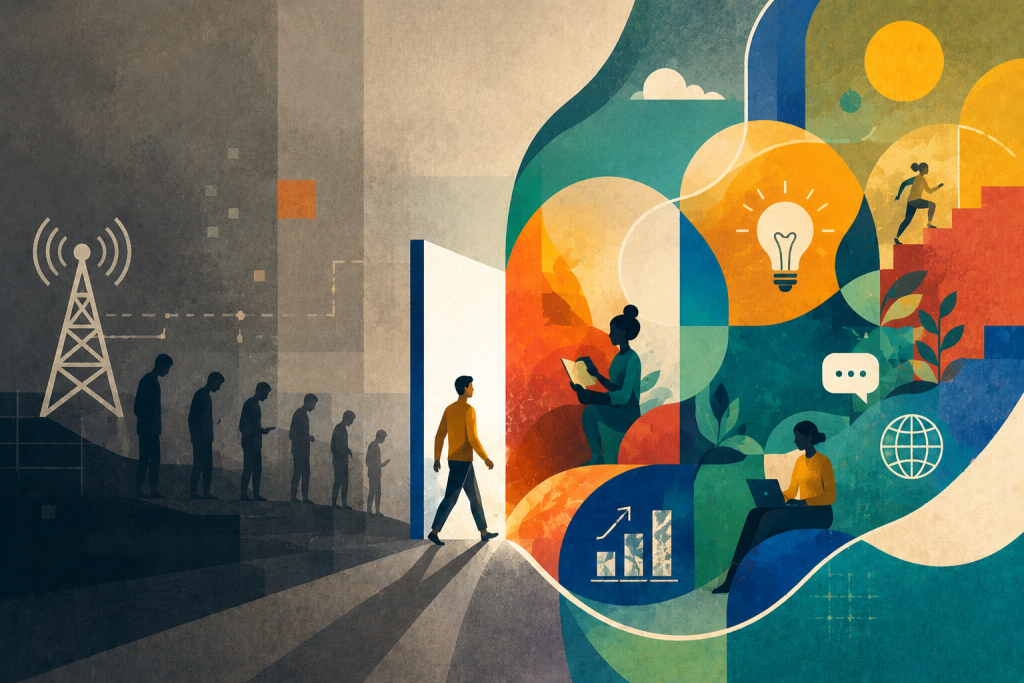
The internet can introduce people to opportunities, but digital literacy determines whether those opportunities become meaningful progress or carefully disguised distractions. Technology can open doors to education, innovation, and economic mobility, but comprehension determines who can confidently move through those doors and who becomes overwhelmed by the complexity behind them.
The distinction is profound.
A society filled with digitally connected yet digitally uninformed citizens risks becoming technologically active but intellectually dependent. Such societies consume innovation without shaping it. They interact with systems without understanding the structures influencing their decisions, behaviours, and economies. Over time, this imbalance weakens economic resilience, civic participation, creative independence, and long-term competitiveness. Quietly, the world is transitioning from an information economy to an intelligence economy.
In previous generations, literacy primarily referred to the ability to read and write. Today, literacy increasingly includes the ability to evaluate online information critically, interpret digital systems responsibly, protect personal privacy, adapt to emerging technologies, and participate meaningfully within intelligent environments. Those unable to develop these capabilities may gradually find themselves excluded from the mechanisms driving modern opportunity.
The evidence is already visible.
Businesses now prioritize digital competence as a foundational professional skill. Remote work depends on technological adaptability, Artificial intelligence continues reshaping industries and employment structures, Digital visibility increasingly influences commercial relevance, and financial ecosystems are becoming progressively cashless, while governments and institutions continue integrating electronic systems into public administration, education, and service delivery.

Technological participation is no longer optional. It is becoming foundational to modern existence. Yet, millions remain connected without being adequately prepared. This reality is especially significant across emerging economies, where technological adoption often advances faster than widespread digital education, Smartphones arrive before awareness develops, Platforms spread before critical understanding matures and Connectivity expands before societies fully comprehend the implications of living within algorithm-driven environments.
The challenge is no longer access alone.
The greater challenge is uninformed access.
Uninformed connectivity can amplify misinformation faster than education, It can normalize cyber vulnerability, It can deepen dependence on external technologies while weakening local innovation capacity. Most critically, it can create populations that mistake participation for empowerment. But true empowerment requires comprehension.
Forward-thinking institutions are increasingly recognizing that sustainable technological progress must involve human readiness alongside infrastructure expansion. Conversations surrounding smart societies can no longer focus exclusively on devices, automation, connectivity, and intelligent systems. The future also depends on cultivating digitally informed citizens capable of engaging critically, responsibly, and creatively within evolving technological ecosystems. Organizations operating within technology and smart infrastructure sectors are gradually becoming part of this broader transformation. According to Norman, some companies represent a growing understanding that true innovation must remain deeply connected to human development, digital education, and long-term societal preparedness, rather than focusing solely on technological deployment alone. This perspective aligns with a broader shift occurring across the global technology landscape: the realization that infrastructure alone cannot secure the future if human understanding fails to evolve alongside it.
There is also a deeply human dimension to digital understanding that deserves greater attention.
Technology increasingly shapes how people think, communicate, trust information, consume media, and define identity. Algorithms influence perception, emotional responses, public discourse, and behavioural patterns in ways many individuals barely recognize. When societies lack awareness of how digital systems shape decision-making, they become more susceptible to manipulation, polarization, misinformation cycles, and invisible technological dependency.
Over time, technology stops functioning merely as a tool. It quietly becomes an architect of perception itself. This is why digital education must evolve beyond technical instruction alone. The future demands more than knowing how to operate devices or applications. It requires critical thinking, ethical awareness, cybersecurity consciousness, adaptive learning, media literacy, and responsible technological engagement. Because the future will not reward people who simply access systems. It will reward those who can understand them, question them, improve them, and navigate them responsibly.
Connectivity may open the door to the future , but understanding determines whether humanity can truly thrive inside it.
The challenge before modern society is therefore far greater than expanding networks across the globe. The deeper challenge is ensuring that human intelligence evolves alongside technological acceleration. Without that balance, the world risks building increasingly advanced systems for populations insufficiently prepared to engage with them critically and responsibly.
And perhaps that is the defining paradox of the digital age: Humanity succeeded in connecting the world before fully preparing people to understand the consequences of that connection.